
Building the Next Generation of MENA’s Digital Connectivity
As MENA’s digital landscape evolves, the demand for resilient, diverse and high-performance connectivity is moving well beyond traditional bandwidth requirements. The rapid growth of AI, hyperscale data centres, cloud services and latency-sensitive applications is creating a new set of priorities for carriers and digital infrastructure providers—where route diversity, low latency, resilience and operational agility are becoming strategic necessities.
In this edition, we speak with Naveen Rajagopalan, CCO of Kalaam Carrier Solutions, about how the region’s connectivity landscape is changing and the role of carrier-neutral infrastructure in supporting its next phase of digital growth.
Naveen discusses Kalaam Carrier Solutions’ growing regional network, including KNOT and Kalaam Iraq Transit, and how alternative terrestrial routes can strengthen connectivity between the Gulf and Europe while providing greater resilience and diversity. He also shares insights into the company’s digital-first approach through its Klik platform and KYC (Know Your Circuit) service assurance capabilities.
Looking ahead, Naveen explores how AI, hyperscalers and data centres are reshaping network requirements across MENA—and why the region has the potential to evolve from a traditional transit corridor into a global AI and digital infrastructure hub connecting Europe, Asia and Africa.
Kalaam Carrier Solutions positions itself as a single face for the carrier community and as a carrier-of-carriers, supported by a growing MENA network that includes the KNOT terrestrial system and Kalaam Iraq Transit. How is this infrastructure portfolio helping Kalaam differentiate itself among global carriers, hyperscalers and content providers looking for resilient, diverse and low-latency routes through the Middle East?
I think our biggest differentiator is that we are not trying to be everything to everyone. We are focused on solving a very specific problem for the Carrier and hyperscaler community which is – how do you move traffic in and across the Middle East with the right combination of latency, diversity, resilience and commercial flexibility?
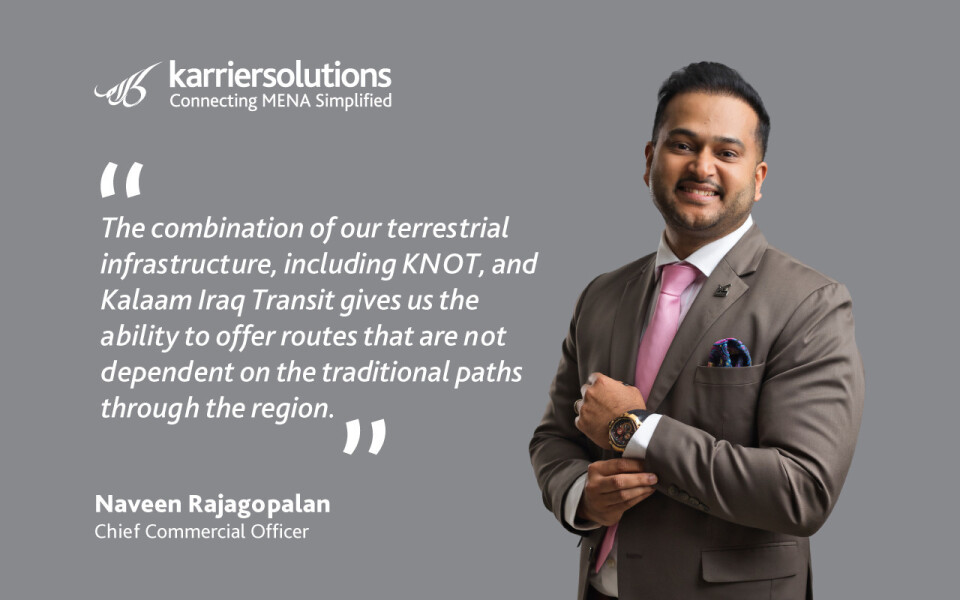
The combination of our terrestrial infrastructure, including KNOT, and Kalaam Iraq Transit gives us the ability to offer routes that are not dependent on the traditional paths through the region. That is becoming increasingly important as customers look beyond simply buying bandwidth and start looking at the underlying route, physical diversity and how quickly they can restore traffic if something happens. For global carriers, hyperscalers and content providers, we effectively become a single interface into a fairly complex regional ecosystem. They don't need to manage multiple relationships across different countries and operators. We can bring the infrastructure, local relationships and operational capability together and provide an end-to-end solution. I also think our agility is important. We are able to quickly look at the customer's requirement from a route and network perspective rather than trying to push them onto one particular network. That is where I see our carrier-of-carriers model becoming increasingly valuable.
Kalaam Iraq Transit has been positioned as an alternative route between the GCC and Europe, offering greater route diversity and resilience. What has been the response from international carriers and customers so far, and how do you see this route changing the connectivity landscape between the Gulf and Europe?
The response has been extremely positive because the market understands that route diversity is no longer a technical preference; it has become a strategic requirement. The disruptions and vulnerabilities associated with traditional subsea corridors and the geo political situations, have highlighted the importance of having a truly diverse terrestrial alternative. International carriers, hyperscalers and large enterprises are actively evaluating not just capacity, but also route resilience, restoration capabilities and geopolitical risk mitigation. What has resonated particularly well with customers is that Kalaam Iraq Transit provides a genuine alternative rather than simply another version of the same path. By creating a terrestrial corridor from the GCC into Europe via Iraq and Turkey, we help customers diversify away from traditional choke points while maintaining low latency and a predictable operational mode. I believe this route will gradually reshape how operators think about connectivity between the Gulf and Europe. Historically, the discussion has been centered around bandwidth and price. Going forward, the conversation will increasingly focus on route intelligence, resilience and business continuity. Kalaam Iraq Transit gives customers a strategic option that strengthens network redundancy while supporting the growing demands of cloud, AI and digital transformation workloads.
From a commercial perspective, what are your key priorities for expanding Kalaam Carrier Solutions’ carrier ecosystem and scaling services such as IP transit, wavelengths and cloud interconnection? And which markets or customer segments do you see offering the greatest growth potential?
Our first priority is to continue strengthening our position as a carrier-neutral partner for international carriers, hyperscalers and content providers. We want to simplify Middle east connectivity for customers to access capacity and cloud ecosystems across the region through a single commercial and operational interface.
This is where Klik plays a very important role in our strategy. Klik is our proprietary 360 degree customer platform that enables customers to quote, order, monitor and manage services through a single portal with complete visibility across the service lifecycle. The wholesale industry is increasingly moving towards digital engagement, and we see Klik as a key differentiator that allows us to scale efficiently while providing a significantly better customer experience. It gives customers transparency, self-service capabilities and faster access to services, while enabling Kalaam to automate many of the traditional processes associated with wholesale service delivery.
From a product perspective, we continue to see strong growth opportunities across IP Transit, high-capacity wavelengths, cloud interconnection and resilient international transport solutions. The convergence of AI, cloud adoption and data center growth is creating unprecedented demand for scalable, low-latency connectivity across the region.
We are also seeing growing demand from latency-sensitive industries such as financial trading, capital markets, gaming platforms and real-time digital services. As transactions, gaming workloads and AI-driven applications become increasingly time critical, milliseconds matter. Kalaam is strategically positioned across many of the region's key financial exchanges, data centers and interconnection hubs, allowing us to deliver ultra-low-latency connectivity solutions that support these demanding use cases. For financial institutions, low latency can directly influence trading performance and market access, while for gaming and content providers it translates into a better end-user experience and higher customer engagement.
In terms of customer segments, hyperscalers and cloud providers remain a major growth driver as they continue to expand their regional footprint. We also see significant opportunities with financial institutions, exchanges, gaming providers, global content platforms and international carriers that require deterministic latency, route diversity and resilient infrastructure. As digital ecosystems mature across MENA, these customers are looking for partners that can combine infrastructure ownership, regional reach and operational agility, which aligns strongly with Kalaam's carrier-of-carriers strategy.
The wholesale connectivity industry is increasingly moving toward digital-first customer experiences. How are platforms such as the MEF-certified Klik portal, automation and emerging AI capabilities changing the way carriers order, provision, monitor and manage connectivity—and what can customers expect next?
The wholesale connectivity industry is going through the same transformation that we have seen in cloud and enterprise IT. Customers no longer want to rely on emails, spreadsheets and manual processes to manage critical network services. They expect real-time visibility, on-demand access and a digital experience that allows them to operate with greater speed and efficiency.
That shift is exactly why we developed Klik. Our vision was to create a single digital environment where carriers, hyperscalers, content providers and enterprise customers can engage with Kalaam throughout the entire service lifecycle. Through Klik, customers can access quotations, manage orders, monitor service performance, track tickets, review SLAs and gain visibility into their network services from a single platform. The objective is not simply to digitize existing processes but to remove operational friction and provide customers with greater transparency and control.
KYC (Know Your Circuit) is our cloud-native service assurance module built inside Klik and, arguably, the most technically distinctive thing KCS has built. It solves a problem that every carrier selling international capacity quietly accepts: once a circuit is provisioned and handed over, neither party has real-time, end-to-end visibility of its performance.
KYC changes this through Smart SFP technology — intelligent transceivers embedded at the network edge that deliver sub-second performance readings without requiring changes to customer CPE. The platform is built around three pillars:
• Visibility: A single pane of glass showing every circuit, every site, in real time — from the KCS MPLS core to the last-mile provider network and into the customer building.
• Action: A self-service portal that gives customers direct control over key assurance tasks, including service activation testing compliant with RFC2544 and Y.1564 standards, bandwidth metering with microburst detection, and diagnostics initiated without involving the KCS NOC.
• Insights: Continuous SLA KPI tracking, granular performance analytics, and multi-source third-party data ingestion for enriched historical reporting — all exportable for compliance and governance purposes.
AI, hyperscalers and data centers are fundamentally changing bandwidth and latency requirements across MENA. Looking ahead, how do you expect demand for high-capacity fiber routes, diverse terrestrial and submarine connectivity, and carrier-neutral infrastructure to evolve—and what role does Kalaam Carrier Solutions aim to play in building the region’s digital backbone?
We are witnessing the beginning of a fundamental shift in how digital infrastructure is designed and consumed across the region. The growth of AI, cloud computing, data localization requirements and hyperscale data centers is driving a completely different set of network requirements than what we saw even five years ago. The focus is no longer simply on bandwidth. Customers are demanding greater capacity, deterministic low latency, route diversity and the ability to move large volumes of data between data centers, cloud environments and end users with absolute reliability.
As AI workloads scale, network infrastructure will become just as critical as computing infrastructure. The organizations that succeed will be those that can combine high-capacity transport, cloud access, resilient international connectivity and intelligent traffic routing into a unified ecosystem. We expect demand for diverse terrestrial routes and carrier-neutral interconnection points to increase significantly as customers seek to balance performance, resilience and data sovereignty requirements.
We also see significant growth coming from latency-sensitive sectors such as financial services, electronic trading platforms, gaming providers and real-time digital applications. As financial institutions and exchanges become increasingly interconnected, and as gaming and content platforms expand across the region, demand for ultra-low-latency connectivity will continue to accelerate. Kalaam is strategically positioned across many of the region's major data centers, interconnection hubs and financial ecosystems, enabling us to support these high-performance use cases.
Our role is to provide the foundational infrastructure that connects these digital ecosystems together. Through assets such as KNOT, Kalaam Iraq Transit, our international partnerships and our growing regional footprint, we are creating a platform that enables carriers, hyperscalers, financial institutions, content providers and enterprises to connect efficiently across MENA and beyond. Our ambition is not simply to transport traffic, but to become the trusted digital infrastructure partner that helps power the next phase of the region's digital economy.
If you look at MENA’s digital infrastructure five years from now, what is the one development you believe will have the greatest impact on the region’s connectivity landscape—and what should the industry be doing today to prepare for it?
If I had to identify one transformative development, it would be the emergence of MENA as a global AI and digital infrastructure hub connecting Europe, Asia and Africa.
Historically, the region was often viewed as a transit corridor for international traffic. Over the next five years, I believe MENA will increasingly become a destination in its own right for hyperscale data centers, AI infrastructure, cloud platforms, content ecosystems and digital services. The combination of strategic geography, government investment, digital transformation initiatives and growing demand for sovereign digital infrastructure creates a unique opportunity for the region.
To prepare for this future, the industry must focus on building interconnected digital ecosystems rather than isolated infrastructure assets. This means investing in greater route diversity, expanding carrier-neutral interconnection facilities, enabling open access to cloud and data center ecosystems, and ensuring that networks are designed to support the massive scale and performance requirements of AI-driven applications.
Equally important is embracing automation and intelligent network operations. As capacity requirements continue to grow exponentially, traditional operational models will struggle to keep pace. The future network must be increasingly automated, data-driven and capable of adapting dynamically to changing customer and application requirements.
Ultimately, the winners in the next decade will not be those who simply own the most infrastructure. They will be the organizations that create the most connected, resilient and intelligent digital ecosystems. At Kalaam, our objective is to help build that ecosystem by combining infrastructure, interconnection, automation and customer-centric innovation into a platform that enables regional and global digital growth.
Interview with Eng. Sultan Al Wahaibi, CEO of Oman Broadband Company
extending his warmest congratulations to His Majesty on the occasion of the 54th National Day Sultan AlWahaibi: “Oman Broadband supports the Ministry’s and Telecommunications Regulatory Authority (TRA) initiatives within the National Program for Digital Economy and Sustainable Development in the Sultanate of Oman through strategic partnerships.” 886,537 fiber optic units in Oman […]

Fiber Connectivity: Aligning Nations Like UAE and Iraq for Better Capacities
Collaboration and synchronization are paving the way for an expected surge in fiber-to-the-home (FTTH) connections. In an exclusive interview with Telecom Review, Dr. Alaa Mousa, CEO at EarthLink Telecommunications and President of Fiber Connect Council MENA, shared his insights on this matter.

How fibre brings ‘simple, reliable and durable’ connectivity
What does a fibre-connected MENA mean? Fibre-based broadband is the new generation of broadband – much faster and more reliable. Fibre optic cable has less interference, keeps the signal strength over much greater distances and operates at a higher frequency rate. Higher frequency means greater bandwidth, which means faster connection speeds for individual users […]